Copyright and permissions
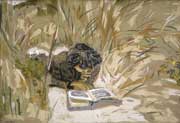
Édouard Vuillard (1868–1940) Femme lisant, c. 1908, Fitzwilliam Museum, Cambridge. Distemper on paper, 44.5 × 64.6 cm. © Fitzwilliam Museum, Cambridge, 2015.
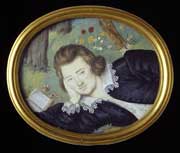
Nicholas Hilliard (1547–1619) Henry Percy, 9th Earl of Northumberland, c. 1595, Fitzwilliam Museum, Cambridge. Bodycolour on vellum, 5 × 6 cm. © Fitzwilliam Museum, Cambridge, 2015.
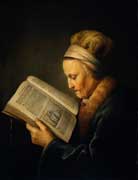
Gerard Dou (1613–75) Rembrandt’s Mother, c. 1630, Rijksmuseum, Amsterdam. Oil on canvas, 71 × 55.5 cm. © Rijksmuseum, Amsterdam, 2006.
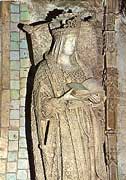
Gil de Siloe (?–1501) The tomb of Queen Isabel of Portugal, 1489–93, Burgos Cathedral. Limestone, figure 146 cm long.
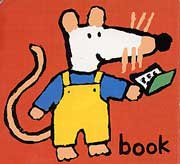
Lucy Cousins (1964–) Maisy’s Favourite Things (London, Walker Books, 2001), p. 2. Illustration © 2001 Lucy Cousins. From Maisy’s Favourite Things by Lucy Cousins, Audio Visual series © Universal Pictures. Maisy™: Maisy is a registered trademark of Walker Books Ltd. Reproduced by permission of Walker Books Ltd, London SE11 5HJ.
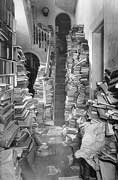
Photograph of Canon Jenkins’s house in Tom Quad, Christ Church, Oxford, in the 1930s [from Christ Church Annual Report, 1996, produced by The Running Head]. Canon Jenkins stored, apparently, all of his 90,000 books in his house.
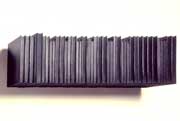
Rachel Whiteread (1963–) Black Books, 1996–7, black pigmented plastic and steel, 29 × 101 × 23 cm [from Jesus College, Cambridge, Sculpture in the Close 2003, exhibition catalogue produced by The Running Head]. © Rachel Whiteread, 2006. By permission of the artist.
Codex Amiatinus, early eighth century (before 716), Monkwearmouth, Jarrow, 1, f. Vr. Biblioteca Medicea Laurenziana, Florence. Ink on vellum, each page 50.5 × 34 cm. ‘The book weighs 34 kg, and its 2,060 pages were written on the skins of 515 young calves, testifying to the wealth of the new aristocratic monasteries emerging in northern Europe (and an indication of the local diet) …’ (Lawrence Nees, Early Medieval Art, Oxford University Press, 2002, p. 165 [produced by The Running Head]).
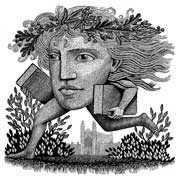
Harry Brockway, The Running Head greetings card 2004. Wood engraving printed letterpress from the block by the Rampant Lions Press, Over, Cambridgeshire, 10 × 10 cm. © Harry Brockway, 2004.
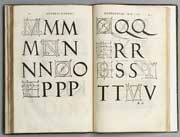
Albrecht Dürer (1471–1528) Alberti Dvreri pictoris et architecti praestantissimi De vrbibvs … (Paris, Officina Christiani Wecheli, 1535). Illustrated book, 35 cm high.
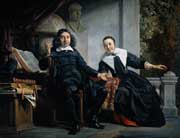
Jan de Bray (c. 1627–88) The Harlem Printer Abraham Casteleyn and His Wife Margarieta van Bancken, 1663, Rijksmuseum, Amsterdam. Oil on canvas, 84 × 108 cm. © Rijksmuseum, Amsterdam, 2006.
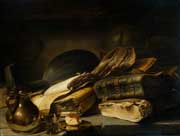
Jan Lievens (1607–74) Vanitas Still Life, c. 1630, Rijksmuseum, Amsterdam. Oil on canvas, 91 × 120 cm. © Rijksmuseum, Amsterdam, 2006.
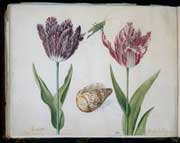
Jacob Marrel (c. 1613–81) Two Tulips, a Shell and an Insect, 1639, Rijksmuseum, Amsterdam. Brush watercolour and body colour on parchment, 26.1 × 33.5 cm. © Rijksmuseum, Amsterdam, 2006.
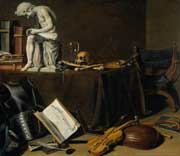
Pieter Claesz (1597/8–1660) Vanitas Still Life with the Spinario, 1628, Rijksmuseum, Amsterdam. Oil on panel, 70.5 × 80.5 cm. © Rijksmuseum, Amsterdam, 2006. The Spinario is a first-century BC Roman statue of a boy pulling a thorn out of his foot.
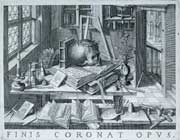
Hendrick Hondius the Elder (1573–1650) Vanitas Still Life, 1626, Rijksmuseum, Amsterdam. Engraving on parchment, 42 × 27.6 cm. © Rijksmuseum, Amsterdam, 2006. The elder Hondius was a print-maker and print publisher working from The Hague.
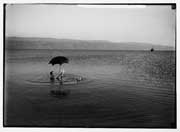
Anon (American Colony Photo Department), photograph of a man floating and reading a book in the Dead Sea, c. 1935, Library of Congress no. LC-DIG-matpc-05917, dry plate 12.7 × 18 cm glass negative. © Library of Congress, 2006.
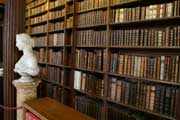
Photograph taken in the Upper Library, Christ Church, Oxford. The bust is of Proserpine, by Hiram Powers (1805–73). © Biljana Scott, 2006, www.biscott.co.uk.
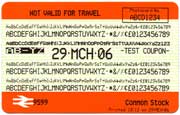
Test railway ticket found at Brighton Station 29 March 2006, photo © Paul Smith, 2006, www.flickr.com/photos/
paulsmith/119762696/.
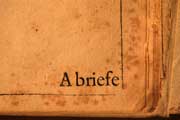
Detail from the last page of the Book of Revelation, from the Geneva (‘Breeches’) Bible (London 1599), photo © Michael Reeve, 2006, www.flickr.com. The soubriquet derives from this edition’s version of Genesis 3, 7: ‘Then the eyes of them both were opened, and they knewe that they were naked, and they sewed figge tree leaues together, and made them selues breeches.’ ‘A briefe’ is the running foot sometimes used in pre-modern book production to anticipate the first words on the next page – in this case indexes that help locate specific characters or stories.
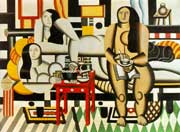
Fernand Léger (1881–1955) Three Women, 1921, Museum of Modern Art, New York. Oil on canvas, 183.5 × 251.4 cm. © 2006 Artists Rights Society (ARS) New York/ADAGP, Paris.
Photograph of a woman waiting for a parade in Ridgewood, New Jersey, 1996, © Roy Caratozzolo, 2006, www.tozzophoto.com.
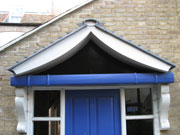
A porch in St Edward’s Passage, Cambridge. The version in the main pages was heavily Photoshopped to add bricks on the left. It was originally the back entrance to a bookshop on King’s Parade. Photo © David Williams, 2009.
Bill Woodrow, Timetable, at the Jesus College Sculpture in the Close exhibition, 2007. The bronze, about the size of a coffee table, has lettering on the top: ‘L’Apiculture: histoire et techniques’. From the catalogue by Rod Mengham [produced by The Running Head]: ‘The meaning of Woodrow’s book-like objects is itself elusive and hermetic, although the decisive choice of imagery and portentous associations hint at the existence somewhere of a key that might unlock the puzzle.’ Photo © Charlotte Davies, 2007.
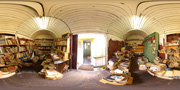
Equirectangular panorama (eight photos) of ‘La caverne aux livres’ in Auver-sur-Oise Photo © gadl, 2009.
A heavily metaphorical (I hope) sign on a building in Carrizozo, New Mexico. Photo © H. Wren, 2009.
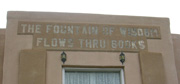
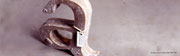
Photo and image © Marion Mayr 2002–2007. From her ‘The Origin of Letters by Means of Human Selection’ project, http://www.marionmayr.net/
?site=p16_originofletters.html
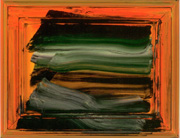
Howard Hodgkin, Old Books, 2006, private collection, London. Oil on wood, 55.6 × 71.8 cm. © Howard Hodgkin, 2006. By permission of the artist.
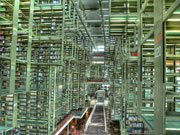
The National Library, Mexico, looking very Borgesian. (Copyright details not available.)
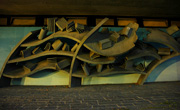
‘Magic Books’ street sculpture, Vienna. Photo © ManimMac, 2009.
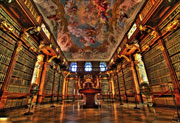
Melk Abbey library, near Vienna. Photo © Nacaseven, 2009.
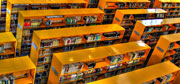
Orange shelves in a library. The shapes and composition (if not usability) work better upside down. (Copyright details not available.)
Photocollage of Shakespeare and Company bookshop in Paris. Photo © ManimMac, 2009.
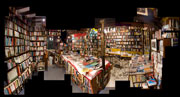
Photo © ajwpip, 2009.
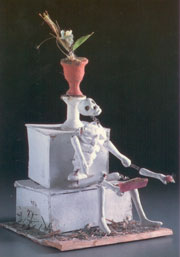
Skeleton on a monument, holding a book; used in a ‘Day of the Dead’ ceremony, Guadalajara, Mexico, 1898. Photo © Cambridge University Museum of Archaeology and Anthropology, 2015.
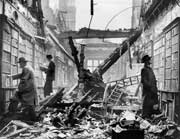
‘Keep calm and carry on’ indeed: browsers in the remnants of Holland House Library, Kensington, London, after a Luftwaffe bombing raid in 1940 destroyed the roof. Copyright © English Heritage.NMR 2009, www.englishheritageimages.com
Many hours have been given to finding and contacting copyright holders. If you are one of those people, and have noticed that the information is wrong, please contact The Running Head via the link below.